
How to Import Spanners From India to the UK: A Practical B2B Importer’s Guide
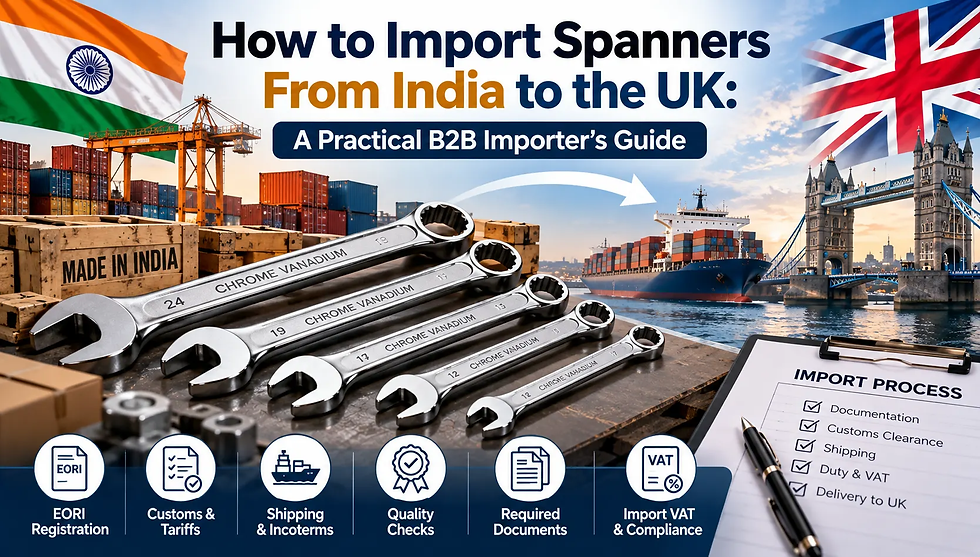
Importing forged hand tools from India offers UK tool brands, motor factors, and industrial stockists a dependable route to competitive landed costs, high-spec Chrome Vanadium metallurgy, and private-label flexibility.
However, moving freight smoothly from Indian manufacturing clusters through British customs clearance requires understanding trade compliance, logistics corridors, documentation, and quality controls before the container leaves the factory floor.
How to Import Spanners from India to the UK
To import spanners from India to the UK, follow an 8-step trade workflow:
Secure a UK EORI number
Finalize engineering drawings and technical standards (BS 7586 / ISO 1711-1)
Approve pre-production golden samples
Contract under clear Incoterms (FOB Mundra/JNPT or CIF UK Port)
Classify goods under Commodity Code 8204 11 00 (non-adjustable) or 8204 12 00 (adjustable)
Arrange pre-shipment inspection (PSI/AQL)
Move cargo via ocean container through Felixstowe, Southampton, or London Gateway
Complete UK customs entry via CDS and pay applicable import VAT and tariffs.
Who Is This Import Guide For?
This practical reference is written for UK-based hardware distributors, hand-tool brand owners, wholesale importers, and aftermarket procurement managers planning initial or scaled container shipments of hand tools from Indian manufacturers.
Step 1: Establish Your UK Import Legal Requirements
Before engaging a freight forwarder or wiring a production deposit, verify that your UK business setup is legally trade-ready.
UK EORI Number: Any business moving commercial cargo into Great Britain must hold an Economic Operators Registration and Identification (EORI) number starting with GB. Without this, goods will stall at the UK port of entry, accumulating severe demurrage charges.
VAT Registration: While non-VAT registered companies can technically import, holding VAT registration allows you to utilize Postponed VAT Accounting (PVA), which lets you account for 20% import VAT on your periodic VAT return rather than paying upfront cash at customs clearance.
Customs Declaration Service (CDS): Ensure your UK customs clearance agent or freight forwarder is linked to your business account on the UK Customs Declaration Service platform.
Step 2: Accurate Tariff Classification and Duty Rates
Wrenches and spanners fall under Chapter 82 of the UK Integrated Online Tariff. Misclassification leads to delayed clearance, penalty audits, or overpaid duty.
Product Category | UK Commodity (HS) Code | Description | Standard UK Global Tariff (Indicative) |
Non-Adjustable Hand Spanners | 8204 11 00 00 | Open-ended, ring, combination spanners | 0% to 2% (Check live UK Trade Tariff schedule) |
Adjustable Spanners & Wrenches | 8204 12 00 00 | Shifting spanners, adjustable jaw tools | Standard tariff rate |
Interchangeable Spanner Sockets | 8204 20 00 00 | Socket bits, drive sockets, socket handles | Standard tariff rate |
Pro-Tip for Importers: Always confirm the exact 10-digit code with your UK freight forwarder or HM Revenue & Customs (HMRC) before issuing the commercial invoice.
Step 3: Material Specifications and Technical Alignment
A common pitfall for first-time importers is contracting on price before locking down engineering specifications. When issuing a Purchase Order (PO) to an Indian manufacturer, define precise material and performance parameters:
Metallurgy: Differentiate between drop-forged Chrome Vanadium (Cr-V) for professional trade use and Carbon Steel (C45/EN9) for consumer or light utility sets.
Performance Standards: Reference recognized standards such as BS 7586 (combination wrenches), BS 192 (open-ended wrenches), and ISO 1711-1 (minimum hardness and proof torsion torque).
Jaw Tolerances: Specify ISO 691 to ensure standard width-across-flats tolerances, preventing loose jaw fit and fastener rounding.
Corrosion Resistance: For satin or bright mirror chrome electroplating, mandate minimum hours under salt spray testing (ASTM B117 / ISO 9227) to safeguard against damp transit conditions and UK workshop storage.
Step 4: Golden Sample Approval Before Mass Production
Never approve container manufacturing based on digital drawings or catalogue photos alone.
Pre-Production Prototypes: Request signed-off production samples ("golden samples") showing the exact forged branding, laser marks, jaw profile, and surface finish.
Physical Dimensional Check: Measure jaw clearances, ring thickness, and overall tool weight.
Destructive Testing: Carry out independent or factory-witnessed torque and Rockwell hardness tests.
Retention: Keep one sealed approved sample in your UK office; leave a duplicate signed sample at the manufacturing facility as the production baseline.
Step 5: Choosing the Right Incoterms for Indian Sourcing
Commercial Incoterms dictate who pays for freight, who carries transit risk, and where legal ownership transfers:
FOB (Free on Board - Mundra / Nhava Sheva): Best suited for experienced UK importers. The Indian manufacturer pays domestic freight, terminal handling (THC), and customs clearance up to the vessel in India. You choose your preferred UK freight forwarder, control ocean freight rates, and direct routing.
CIF / CFR (Cost, Insurance & Freight - Felixstowe / Southampton): Suitable for smaller shipments. The supplier arranges and pays for ocean shipping to your designated UK seaport. However, destination terminal handling fees at the UK port can occasionally be higher than anticipated.
DDP (Delivered Duty Paid): The supplier handles everything to your UK warehouse doors. While low-effort, it is rarely cost-effective for full container loads (FCL) of industrial hand tools, as suppliers add administrative buffers to shipping estimates.
Step 6: Pre-Shipment Quality Control (PSI)
Once production is finished, arrange a Pre-Shipment Inspection (PSI) before releasing the final balance payment:
AQL Standards: Conduct an inspection using ISO 2859-1 (AQL Level II) for visual, dimensional, and packaging defects.
Moisture and Packaging Checks: Maritime transit across equatorial waters exposes steel to high humidity. Ensure individual tools are properly oiled or sealed in poly-sleeves, master cartons contain silica gel desiccant packs, and pallets are heat-treated to ISPM 15 export standards.
Marking and Barcode Scans: Verify EAN-13 barcodes, SKU labels, carton shipping marks, and country-of-origin markings ("Made in India") are visible and clear.
Step 7: Ocean Freight Corridors and Shipping Timelines
Most industrial hand tools originate in manufacturing hubs such as Jalandhar, Ludhiana, or surrounding Northern industrial zones.
Inland Rail Transit (ICD to Port): 4 to 8 days.
Export Customs & Port Loading: 3 to 5 days.
Ocean Transit Time (West Coast India to UK): Typically 25 to 35 days under normal Suez routing (or 38–48 days via Cape of Good Hope during maritime diversions).
UK Port Clearance & Inland Haulage: 3 to 5 days.
Realistic Total Lead Time: Allow 60 to 90 days from purchase order confirmation to stock arrival at your UK facility.
Step 8: Mandatory Import Documentation Checklist
Ensure your Indian supplier provides verified original documentation prior to the vessel’s arrival in British waters
Bill of Lading (B/L) or Sea Waybill: The fundamental legal document confirming ownership and freight transport.
Commercial Invoice: Must detail accurate seller/buyer info, HS codes, unit prices, total value, Incoterms, and EORI number.
Packing List: Detailed breakdown of gross/net weights, carton dimensions, and piece counts per pallet.
Certificate of Origin (CoO): Proves country of manufacture, essential for duty verification.
Mill Test Certificates (MTC): Confirms chemical analysis of the steel billet batch (Cr-V / Carbon Steel).
Mill Inspection & Torque Test Reports: Internal or third-party quality sign-offs verifying compliance with agreed DIN/ISO limits.
UK Sourcing Checklist: 10 Essentials Before Wire Transfer
Before authorizing initial production deposits or final balance releases:
Valid UK EORI number linked and verified
Correct UK Commodity Code (8204) established
Technical drawings and British/ISO standards agreed in writing
Physical "golden sample" evaluated and retained in the UK
Commercial Incoterm (e.g., FOB Mundra) and payment terms confirmed
Packaging, pallet ISPM-15 compliance, and moisture desiccants specified
Pre-Shipment Inspection (AQL protocol) conducted
Shipping documents cross-checked against invoice values
UK freight forwarder briefed on CDS entry and PVA setup
Inland warehouse unloading arrangements confirmed for container de-stuffing
Frequently Asked Questions
Do imported manual spanners require UKCA or CE markings?
Standard non-powered manual hand tools are generally not subject to mandatory UKCA or CE conformity marking regimes. However, UK importers must still comply with broad product safety rules under the UK General Product Safety Regulations (GPSR), requiring goods to be fundamentally safe, traceable, and clearly identified with UK importer details.
What is the most cost-effective way to ship spanners from India?
Full Container Loads (FCL)—either 20ft or 40ft containers—offer the lowest freight cost per kilogram for dense, heavy steel products like spanners. For initial orders, Less than Container Load (LCL) consolidation is viable, though port handling costs per tonne are proportionately higher.
How do I manage quality consistency on repeat orders?
Document an agreed Technical Specification Sheet covering dimensional tolerances (ISO 691), hardness ranges (Rockwell C), and plating thickness. Tie payment terms to independent pre-shipment inspections (PSI) conducted against the original signed golden sample.
How are import VAT and customs duties handled in the UK?
Import duties are calculated on the CIF value of the shipment. Import VAT (20%) is calculated on the total value of goods, shipping, insurance, and duty combined. VAT-registered businesses can account for this using Postponed VAT Accounting (PVA) without upfront port outlays.


Comments